
The recruitment process for the Assistant Director (BS-17) position within Pakistan’s Ministry of Defence (MOD) is not merely an exam; it is an intellectual marathon designed to filter for the nation’s most astute and resilient minds. Often described as being “like CSS” in its prestige and rigor, this process is a comprehensive evaluation of knowledge, analytical prowess, and psychological fortitude.
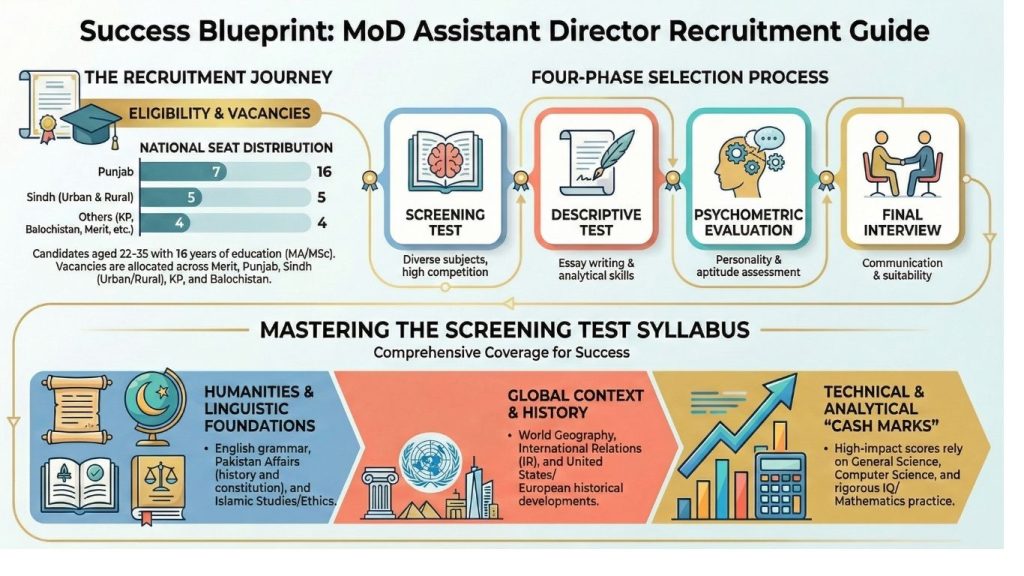
A Multi-Stage of Selection
The path to this coveted position is a sequential, elimination-based journey:
-
The Screening Test: The first and formidable hurdle is an exhaustive MCQ-based examination. Its vast syllabus sets the tone for the entire process, demanding encyclopedic knowledge.
-
The Descriptive Test: Only those who conquer the screening test advance to this stage, which tests the ability to articulate complex ideas in writing.
-
The Psychometric & Psychology Test: Here, potential candidates are checked to see if their behavior, mental toughness, and personality fit the needs of a “powerful” job in national defense.
-
The Interview: The final stage, a direct assessment before a selection board.
Deconstructing the “Very Tough” Screening Test Syllabus
The initial screening test is the defining challenge, covering a breathtaking range of subjects to assess a candidate’s breadth and depth of understanding.
1. Core Languages & Analytical Foundations
-
English: Focus on practical command through vocabulary (synonyms, antonyms, pair of words), error detection (especially in prepositions, parts of speech, and grammar usage), and professional communication standards.
-
Analytical Skills: The IQ, Reasoning, and Mathematics section is singled out as both “dangerous” and a source of “cash marks.” Success here requires intense practice to solve problems accurately under time pressure.
2. The Geopolitical & Historical Canvas
-
World Map & Geography: Requires mastery of both political and physical geography—from capitals and country groupings to continents, oceans, and major physical features.
-
Current Affairs (2023-2026): Candidates must look beyond recent months, developing a sustained understanding of major global issues, summits, agreements, and disputes, with particular emphasis on developments in 2025 and 2026.
-
Pakistan Affairs: Spans the region’s history from 712 AD to the present, covering pre- and post-partition eras. Crucially, it demands a detailed study of the Pakistan Constitution—its articles, amendments, and practical application in the political structure, including parliament and elections.
-
International Relations & Law: Encompasses IR theories, diplomatic terminology, and the study of key international treaties and agreements, both historical and contemporary, within the framework of International Law.
3. Comprehensive Historical Studies
-
European History: Traces major developments from the 1789 French Revolution to the present, including the treaties that shaped the modern world order.
-
US History: Focuses on presidents, electoral processes, and the states.
-
Islamic History & Studies: Treated as two distinct areas: one covering the historical chronology from Pre-Islamic Arabia through the Prophetic era and Khulafa-e-Rashideen, and the other focusing on the tenets of faith—the pillars of Islam and key Quranic Surahs.
4. Supporting Disciplines
-
General & Computer Science: Tests basic biology, astronomy, and increasingly, computer fundamentals.
-
Ethics, Civics, and Social Sciences: Round out the candidate’s profile, assessing moral reasoning and understanding of societal structures.
Strategic Imperatives for Aspirants
-
Constitutional Expertise: A professional, detailed understanding of the Pakistan Constitution’s articles and amendments is non-negotiable and must be linked to the workings of parliament and the electoral system.
-
Treaty & Agreement Literacy: Understanding international agreements is crucial in various disciplines, including Current Affairs (2025-2026), International Law, and the historical settings of European and Indo-Pakistani history.
-
Mastery of “Cash Mark” Sections: Dedicated, timed practice for the IQ, Reasoning, and Mathematics section is critical for securing assured marks and gaining a time advantage.
-
Holistic Current Affairs Preparation: A narrow focus is insufficient. Candidates must build a connected understanding of global events, summits, and disputes over the entire 2023-2026 window.
The Goal: One of the Select Few
The rigorous process culminates in the selection of only 16 candidates for the Assistant Director (BS-17) post, distributed via provincial quota (Punjab: 7, Sindh Urban: 3, Sindh Rural: 2, KP: 1, Balochistan: 1, Ex-FATA: 1, Merit: 1). This distribution underscores the national character of the recruitment.
In conclusion, the MOD Assistant Director recruitment is a testament to the high standards expected in defence sector governance. It seeks individuals who are not just scholars of discrete subjects, but synthesizers of information, agile thinkers under pressure, and persons of unwavering character—truly, a search for a modern-day intellectual sentinel.
MOD Mock test solved free download

