
The pressure of a teaching interview is immense. You’re not just applying for a job; you’re auditioning for a role that will shape future generations. The stakes feel incredibly high, and it’s easy to believe that success comes down to simply knowing your subject matter inside and out. But that’s only part of the story. The most successful candidates understand how to master the subtle, often overlooked aspects of the interview process.
This article reveals five surprising and impactful takeaways distilled from an expert interview guide for Secondary School Teachers (SSTs) . These aren’t just tips; they are strategic shifts in perspective that can transform how you present yourself and prove you’re the right person for the classroom. Master them, and you shift the interview dynamic from a mere qualification check to a demonstration of undeniable expertise.
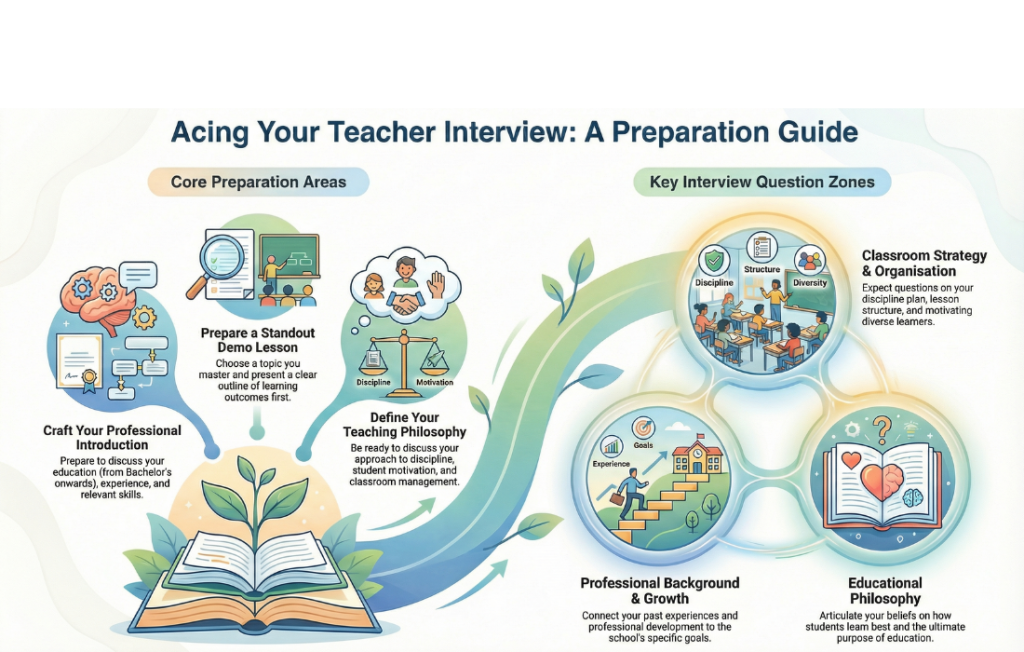
1. Your Self-Introduction Isn’t a Biography, It’s a Strategic Summary
One of the most common mistakes candidates make is responding to “Tell me about yourself” with a long, rambling personal history. A truly effective introduction is concise, professional, and strategic, designed to give the interviewer the most relevant information in the shortest amount of time.
The guide’s approach follows a clear, powerful structure:
- Start with your current role and years of experience.
- State your location and educational qualifications.
- Mention the specific grades you’ve taught and your focus areas.
- Conclude with your specialized skills (e.g., classroom management, digital tools).
This approach immediately positions you as a professional who is organized, respects institutional time, and can distill complex information (in this case, your own career) into its most salient points—a critical teaching skill in itself.
2. The “Micro-Lecture” Proves Your Teaching Skill, Not Just Your Knowledge
The demo lecture is one of the most critical components of a teaching interview, but its true purpose is often misunderstood. The guide provides a powerful example using the “Ideology of Pakistan,” breaking a complex topic into a digestible micro-lesson.
The core components of this effective demo lecture include:
- Introduction: A concise opening statement that sets the stage.
- Key Concepts: Clearly defined pillars like the Islamic Foundation, the Two-Nation Theory, and Social Justice.
- Conclusion: A summary that reinforces the main principles and provides a clear takeaway.
Here’s the secret: the interview panel already knows the subject matter. They are not there to be educated. Their sole purpose is to see if you can perform the core function of the job: teaching. The content of your micro-lecture is merely a vehicle for demonstrating your pedagogical skill. It shifts the focus from proving what you know to showcasing how well you can teach it.
3. Prepare Concrete Answers for Hyper-Specific Scenarios
Interviewers are looking for more than abstract philosophies on education. They want concrete evidence that you have practical, in-classroom experience and a toolkit of strategies to handle real-world challenges. The guide is filled with questions that demand specific, strategy-based answers.
Consider how you would answer these hyper-specific questions from the guide:
- “There are times when you have an extra five or ten minutes left at the end of the period. What types of sponge activities do you use to make the best use of this time?”
- “Describe an active participation technique you use so you know the students understand the concept.”
- “How would you handle cheating?”
Having ready answers for these scenarios is crucial. It proves you’ve moved beyond theory and have developed a set of reliable classroom management and teaching strategies that you can deploy effectively from day one.
4. Your “Why” Is Just as Important as Your “What”
While your technical skills and classroom experience are essential, interviewers are also trying to uncover your core motivation and passion for teaching. These qualities are often what separate a good teacher from a great one. The guide highlights this by including questions that probe your fundamental reasons for entering the profession.
Why do you want to teach at this particular level or this particular subject
What do you like most about teaching?
These questions are your opportunity to share your commitment, resilience, and genuine passion for education. Your answers reveal your underlying philosophy and are key indicators to interviewers that you have the dedication to thrive in a challenging but rewarding career. Your answers to these questions should weave a consistent narrative about your past motivations and your future commitment, proving you are not just qualified, but also dedicated.
5. Your Whole Self Is Being Interviewed—Not Just the Teacher
A school is a community, and interviewers are looking for candidates who can contribute to that community beyond the four walls of their classroom. The guide includes questions that may seem to go beyond the immediate scope of teaching, but they serve a critical purpose. For instance, you might be asked, “What books, concepts or experiences have influenced you the most in your professional development?” or “What extracurricular activities would you be willing to supervise?”
The surprising importance of these questions is about gauging your potential as a long-term institutional asset. A school isn’t just hiring a classroom filler; they’re investing in a colleague. These questions test your potential to be a low-maintenance, high-value team member who might one day lead a club, mentor new teachers, or contribute to curriculum development. It’s about assessing your capacity for future leadership and your ability to enrich the entire school community.
Tell Your Best Story
A successful teacher interview is about more than just having the right answers. It’s about strategically presenting your skills, your practical wisdom, your core motivations, and your whole self. By understanding that your introduction is a summary, your demo is about teaching ability, and your experiences must be concrete, you can tell a more compelling and effective story. By preparing to discuss your “why” and your potential contributions to the school community, you demonstrate that you are not just a capable educator, but the right choice for the role.
Knowing what interviewers are really looking for, which part of your story will you choose to tell?
The Elite Educator’s Commission Interview Strategy Guide
1. The Strategic Landscape of High-Stakes Selection
In the competitive arenas of the SPSC, PPSC, and FPSC, the interview is not a conversation; it is a high-stakes verbal contest and a definitive gatekeeping mechanism. While written examinations measure baseline cognitive ability, the interview panel serves as the final filter to expose gaps in professional identity. The Board routinely disqualifies candidates who view this stage as a mere formality rather than a strategic demonstration of eligibility.
Success is governed by the 50/50 Composition Rule, a strict balance of questioning that assesses the candidate’s total professional value:
- 50% Academic Mastery: Granular interrogation of your subject area (e.g., Literature, Linguistics, or Science) to verify content authority.
- 50% General Pedagogical Philosophy: Evaluation of instructional methodology, classroom psychology, and situational awareness.
Candidates frequently fail not due to a lack of knowledge, but because they neglect the pedagogical half of the equation or fail to project a sophisticated professional brand from the first moment of interaction.
2. Personal Branding: The Official Self-Introduction
The first impression is the foundation of the entire interview trajectory. The board uses this opening to judge your composure and organizational thinking. A weak introduction invites aggressive probing; a structured one commands the room.
The Official Protocol
Candidates must adhere to a rigid professional sequence to avoid the “fatal time-management errors” that signal a lack of prioritization:
- Identity: State your official name exactly as it appears on your National Identity Card (NIC) and academic certificates.
- Education: Command the timeline by beginning with your Bachelor’s level (14 years of education). The Board considers detailing matriculation or intermediate studies a waste of critical interview time. Focus on your highest degrees and institutional prestige.
- Experience: Summarize your professional history, emphasizing current roles and specific instructional achievements.
Strategic Alignment of Personal Interests
Generic hobbies are a missed opportunity. Every interest must be framed as a professional asset that enhances teaching efficacy.
Strategic Alignment of Personal Interests
| Generic Interest | Professional Teaching Competency |
| Analytical Reading | Critical Thinking Pedagogy and Curriculum Development |
| Writing & Publication | Content Mastery and Scholarly Communication |
| Technological Literacy | Modern Instructional Delivery and Ed-Tech Integration |
| Community Organizing | Classroom Management and Leadership |
| Data Analysis | Student Assessment and Evidence-Based Learning |
This professional framing transitions the panel’s focus from your history to your situational awareness.
3. Local Context and Counter-Question Mastery
Interviewers utilize local context questions to test a candidate’s observation skills and cultural pride. An educator who is disconnected from their roots is perceived as lacking the “Shauur” (Awareness/Enlightenment) necessary to inspire students.
The Counter-Question Framework
Candidates must demonstrate deep civic engagement by researching:
- Etymology: The linguistic roots and meanings of your name and your home district.
- Regional Landmarks: Unique cultural features (e.g., Ghotki’s Peera) or local Sufi shrines that define regional identity.
- Economic Drivers: Major industries and industrial setups that sustain the local economy.
- Educational Statistics: Literacy rates and the number of functional colleges in your district.
Sample Probing Strategies
- The Identity Question: “What does your name signify?” (Strategy: Link the meaning of your name to a professional trait, such as “perseverance” or “enlightenment.”)
- The District Question: “What is the economic backbone of your hometown?” (Strategy: Provide specific data to prove you are an observant citizen.)
- The “Shauur” Connection: Use your knowledge of local history to demonstrate that you possess the cultural awareness required to be a community leader.
4. The Demo Lecture and Academic Content Mastery
The Demo Lecture is the physical proof of your instructional delivery. The Board is not looking for a speech; they are looking for Measurable Goals and structural rigor.
Demo Topic Selection Matrix
Strategic topic selection prevents the “backfire” effect that occurs when candidates stray outside their primary training.
- English Candidates: Shakespeare (High-impact; demonstrates command of complex themes and language).
- General/Art Candidates: The 1973 Constitution of Pakistan, the United Nations, or Current Affairs (e.g., the Israel-Palestine conflict).
- Critical Warning: An Arts candidate attempting a Science topic will likely be exposed during technical probing. Stay within your field of mastery.
The Lecture Outline Protocol
To project the image of a “board-ready” educator, you must utilize a structured board-writing protocol:
- Definition: Clear, concise opening of the concept.
- Brief History: The evolution and context of the topic.
- Successes and Failures: Critical analysis of real-world applications.
- Student Learning Outcomes (SLOs): You must explicitly state what the student will achieve. A demo without Measurable Goals is a failure.
5. Pedagogical Theory and Instructional Methodology
Pedagogy is the science of teaching that distinguishes a subject specialist from a professional educator. Mastery of this section proves your eligibility for the role.
Core Teaching Methods
A sophisticated candidate must distinguish between:
- Grammar Translation Method (GTM): Traditional focus on rules and translation.
- Direct Method: Immersion-based teaching without the native tongue.
- Communicative Language Teaching (CLT): Focus on functional use and interaction.
- Eclectic Approach: A modern synthesis of various methods tailored to diverse learner needs.
The Ultimate Goal: Shauur
Panels favor Student-Centered Methods as they indicate modern pedagogical eligibility. You must articulate that the “Aim of Education” is not merely employment or “bread and butter,” but the cultivation of Shauur (Awareness)—transforming a student into an enlightened member of civilization.
6. Operational Excellence: Lesson Planning and Management
Organizational rigor separates the amateur from the professional. You must prove you can maintain structure in a classroom environment.
The Tiers of Planning
Effective teaching requires a three-tiered preparation strategy: Daily, Weekly, and Monthly. This ensures the “Learning Environment” remains focused on engagement rather than just information delivery.
Modern Requirements
The Board expects familiarity with modern educational standards:
SLOs (Student Learning Outcomes): Specific, measurable benchmarks that prove a student has learned. STEM Education: An integrated curriculum focusing on Science, Technology, Engineering, and Medicine/Medical.
Classroom Management Framework
- Grouping: Defend the use of Heterogeneous (mixed ability) grouping to foster peer learning, while acknowledging when Homogenous grouping is necessary for targeted intervention.
- Differentiation: Explain how you handle “Different Ability Levels”—from gifted students to the “educationally deprived”—through individualized instructional pacing.
7. Behavioral Psychology: The Teacher Perceiver Framework
Beyond knowledge, the Board seeks specific “Themes”—the deep-seated beliefs that indicate long-term impact potential. Using terms like “Gestalt” or “Activation” signals that you are a trained professional.
The 12 Perceiver Themes
- Mission: Belief in student self-actualization.
- Empathy: Understanding the student’s state of mind.
- Rapport Drive: The drive to maintain favorable, professional relationships.
- Individualized Perception: Addressing the unique needs of each student.
- Listening: Responsiveness to student input.
- Investment: Satisfaction derived from student growth.
- Input Drive: Constant search for new ideas and materials.
- Activation: Stimulating students to think and feel.
- Innovation: Willingness to implement new, “way-out” techniques.
- Gestalt: A drive toward completeness and perfectionism.
- Objectivity: Responding to the total situation based on facts.
- Focus: Moving in a planned direction toward specific goals.
High-Stakes Scenario Responses
- On Student Insults: “I maintain Objectivity. I recognize the outburst as a symptom of a deeper unmet need, maintaining professional composure while using the incident to build a bridge of Rapport Drive later.”
- On Parent Complaints: “I listen with Empathy, explain the curriculum’s relevance to the child’s growth, and align our goals toward the student’s success.”
- On Respect: “Respect cannot be commanded; it is earned through professional competence and a genuine commitment to student activation.”
8. Conclusion: Closing with Impact
The final minutes are your opportunity to synthesize your entire professional identity into a compelling closing statement.
The Final Pitch: A Model Script
When asked “Why should I hire you?”, deliver a 30-second power statement:
“You should hire me because I offer a unique synthesis of three pillars: First, my Academic Mastery in [Subject], verified by my degree from [University]. Second, my commitment to Pedagogical Excellence, utilizing student-centered methods to foster Shauur and measurable SLOs. Finally, my dedication to this District’s Goals; I am not just looking for a job, but an opportunity to invest in the intellectual and cultural growth of this community.”
Post-Interview Checklist
- [ ] Self-Introduction: Official name used; timeline started at 14 years/Bachelors.
- [ ] District Intelligence: Name meaning, “Peera” or equivalent landmark, and literacy rates memorized.
- [ ] Demo Protocol: Outline prepared with Definition, History, and Measurable SLOs.
- [ ] Pedagogical Vocabulary: Clear distinctions between GTM, Direct, and CLT established.
- [ ] STEM/SLO Definitions: Ready to define STEM (including Medicine) and SLOs accurately.
- [ ] Perceiver Readiness: Ability to use terms like “Gestalt,” “Objectivity,” and “Rapport Drive” in scenario questions.
- [ ] Strategic Mindset: Approaching the session as a competitive verbal contest, not a casual chat.


